Tag Archives: photography

This Has Nothing to do with Photography OR Does It?

Many of you who have taken one of my Photography 101 Workshops know that I believe it is important for us photographers to study different forms of art.  Seek inspiration in music, painting, sculpting, dance, poetry, … all art.

One aspect of art that inspires me the most is when I see someone doing things completely different, coloring outside the lines, thinking outside the box, or however you want to put it.

Watch the video and then think about YOUR art.  What might you do DIFFERENTLY? What might you CREATE using an approach completely different from everyone else?

I love the creativity behind this endeavor described in the video, even though it really has nothing to do with photography.

Be creative. – Be different. – Be you.

Happy Picture Taking!

Kevin Gourley

Share

Pixelstick Fun!

PixelstickI hosted a class the other night demonstrating the use of a PixelStick!

This is a nifty device that is used in light painting. The stick is a little over 6 feet long and has a strip of 200 LEDs that are controlled by a microprocessor that can generate over 16 million different colors at each location.

It can display all sorts of cool patterns and effects, plus you can also load images on an SD card (in Windows BMP format, 200 pixels in height) and the stick can “paint” the image as the user sweeps the Pixelstick across the air.

Here are some examples shot outside our studio at night.  All of these images were totally created in-camera (no Photoshop involved).  The possibilities are endless!

No, the fence is not on fire. The Pixelstick can “paint” artificial flames!  So very cool

Want to know more about the Pixelstick? Check out their website: http://www.thepixelstick.com

Happy Picture Taking!

Kevin Gourley

Share

The Man with the Crooked Nose

I chose this article title because I thought it might attract your attention, mainly out of curiosity.

The man I am talking about is Ansel Adams. He lived 82 years and had a major impact on the art of photography, and yes, he had a crooked nose.  If you search on Google, you’ll find photos of him, and you’ll see, sure enough, he indeed had a crooked nose.

How did that happen? Well, as the story is told, he was injured in the 1906 San Francisco earthquake when he was a little boy.  An aftershock threw him into a garden wall, and his broken nose was never set properly, so it remained crooked the rest of his life.

He started experimenting with photography when he was around the age of 14, following a trip to Yosemite National Park. Over many decades that followed, he perfected his craft of photography and made major contributions to the art and science of photography with a passion to create outstanding images.  His photographic work is known around the world.

I thought I’d share a few quotes by Ansel Adams.  I figure his insights are way more important than mine:

  • “Sometimes I do get to places just when God’s ready to have somebody click the shutter.”
  • “You don’t take a photograph, you make it.”
  • “There is nothing worse than a sharp image of a fuzzy concept.”
  • “A good photograph is knowing where to stand.”
  • “To photograph truthfully and effectively is to see beneath the surfaces and record the qualities of nature and humanity which live or are latent in all things.”
  • “Some photographers take reality … and impose the domination of their own thought and spirit. Others come before reality more tenderly and a photograph to them is an instrument of love and revelation.”
  • “The only things in my life that compatibly exists with this grand universe are the creative works of the human spirit.”
  • “Twelve significant photographs in any one year is a good crop.”
  • “The single most important component of a camera is the twelve inches behind it.”
  • “Photography is more than a medium for factual communication of ideas. It is a creative art.”
  • “A great photograph is a full expression of what one feels about what is being photographed in the deepest sense, and is, thereby, a true expression of what one feels about life in its entirety.”

Most definitely, he was attentive to technical details, perhaps best known for his work with Fred Archer on the development of the “Zone System” for determining optimal film exposure, developing, and printing for perfect rendering of all image tonal values from black to white and all levels (zones) in between. I worked with the Zone System in my earlier years when I spent countless hours in the darkroom.

As I look over the many quotes by Ansel Adams that people post online I am grateful they keep his insights alive for the benefit of us all, but one thing stands out to me.  Most of his greatest insights were about how we see the world, how we appreciate the art of photography, and how we appreciate the beauty of the world around us, and even about how we FEEL.

When you look at the technical details involved in developing the Zone System, we see he was surely great at the technical aspects, but from what I can tell from his many quotes is that the “technical” is secondary to the “art”.  Or as he said, “There is nothing worse than a sharp image of a fuzzy concept.”

As many of you know, this is one of my concerns, that in this age of high tech photography, we can get all geeky about it and focus on fancy gear and miss what is most important, the art.

It is sometimes easier to obsess with “technically perfection” yet ignore the art aspects. We must always remember to focus on the art of photography: composition, emotion, light, shadow, mood, story telling, and so much more.  If we just focus on the technical stuff, we’ve missed out on what is really important.

Focus on what is important.  

By the way, it doesn’t matter that Ansel Adams had a crooked nose.

Happy Creative Picture Taking

Kevin Gourley


Share

Rainy Day Photography

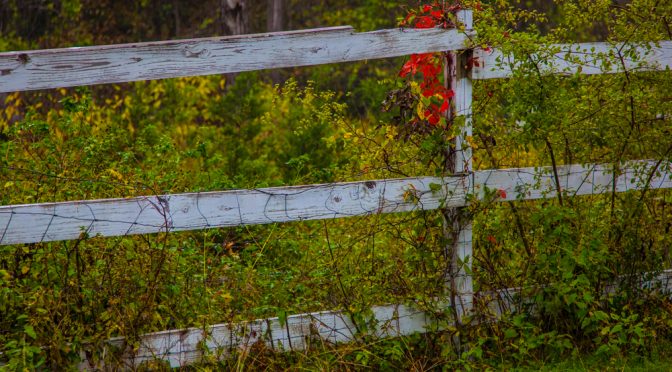
It’s tempting to put away your camera on a rainy day. I encourage you to photograph the rainy days. There is something about the “mood” of a rainy day that is expressed well in art. Also the colors of nature are richer when it rains.  The greens are greener, the browns darken.

While we withdraw from the rain, nature embraces it as the giver of life. Wait for the rain to pass, but do so with your camera in hand.

Photograph the rain. Photograph the water droplets on flowers and leaves.

If there is lightning, that can add an element of visual excitement as well.

If you’re lacking inspiration on what to photograph in the rain, here’s an idea: Give yourself a project!  Search online for quotes about rain, and then try to create a photograph that “fits” with the quote.  Here are some quotes you might use:

  • “Some people walk in the rain, others just get wet.” – Roger Miller

  • “For after all, the best thing one can do when it is raining is let it rain.”  – Henry Wadsworth Longfellow

  • “The way I see it, if you want the rainbow, you gotta put up with the rain.” – Dolly Parton

  • “Into each life some rain must fall, Some days must be dark and dreary.” – Henry Wadsworth Longfellow

  • “Let the rain kiss you. Let the rain beat upon your head with silver liquid drops. Let the rain sing you a lullaby.” – Langston Hughes

  • “Rain is grace; rain is the sky descending to the earth; without rain, there would be no life.” – John Updike

  • “I always like walking in the rain, so no one can see me crying.” – Charlie Chaplin

Happy Picture Taking

Kevin Gourley

Share

The Value of a Photograph

If I go through all of my possessions, I find I really could discard most of them and it wouldn’t bother me all that much. Sure, some of the things I own are “necessities”, but the majority are really possessions of convenience.  Even if they are necessity or convenience items, they are mostly replaceable.

And then there are a few things that fit in the category of “memorabilia”, those items that bring back a special memory, a vacation souvenir, a child toy, maybe even a dog collar.

Confession: I just can’t resist those machines you find in various vacation spots where you put in two quarters and a penny, and it flattens the penny into a souvenir.  I know, it’s kind of goofy, but I like those.  They aren’t just some trinket that was actually made in China.  They are actually made right there, in front of me, at the moment when I was standing there in that spot. I have collected about 20 or so over time.

Another thing that is uniquely “made right there” is a photograph, and that is what I love about photography.  A photograph “captures a moment in time”, embraces it, and hangs onto it for me.  When I want to go back to that moment in time, all I need to do is look at that photograph again.

When it comes to that question of what possessions I truly value, the photographs are the ones I could never discard, nor could I ever replace them.  They are about the only possessions I have that I could honestly say are “priceless” to me.

Some of my priceless photographs aren’t even priceless because they take me back to a memory in my life. They reach even farther back in time, prior to my life.

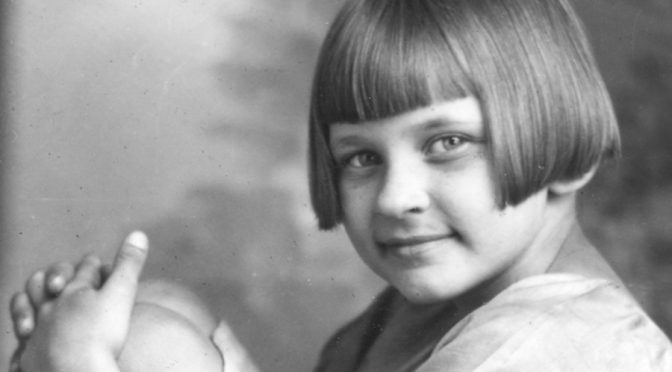
That photo I posted, for example, is a photograph of my mom when she was a little girl.  I believe it was taken by her dad who was a professional photographer almost a century ago.

I love photography because it tells our life story. In the end, when we leave this world, virtually ALL of our possessions, the “necessities” and the “convenience” items, are most worthless to others … except for the photographs.  I love having that photograph of my mom.

Some of the photographs you take today may become priceless possessions to someone else later on.   What a gift.  You can create something “priceless” by simply pressing a button at the right time. That is even better than a flattened penny.

Some day, when I leave this world, my flattened penny collection may become worthless to others, but some of my photographs will live on.

Remember the importance of the photographs you take.  They are the story of the lives of the people you love. They are priceless.

Happy Picture Taking,

Kevin Gourley

Share

Rocky Mountain Summer Photography Workshop – FILLING UP!

Hi Photographers!

I just wanted to give everyone a “heads up” warning if you were contemplating joining us on our Rocky Mountain Photography Workshop this Summer!   Some options now have only ONE SPACE LEFT!

WE WOULD LOVE TO HAVE YOU JOIN US on this grand photographic adventure in beautiful Rocky Mountain National Park!

CLICK HERE FOR MORE INFO and to register

Share

Clarinets and Cameras

I’ve used this analogy in several of my classes, so some of you have already heard this. 🙂

I love music. In many ways I think perhaps it is humanity’s most beautiful and complex art form.  It is an art that can be expressed individually or collectively as a group of musicians in a band or orchestra. Music can be produced and enjoyed in so many different ways, and there is no one “right” way.  Music gets inside us, gets inside our brains. A melody, words in a song, can inspire us, bring us to tears, make us smile, take us back to a moment in time.

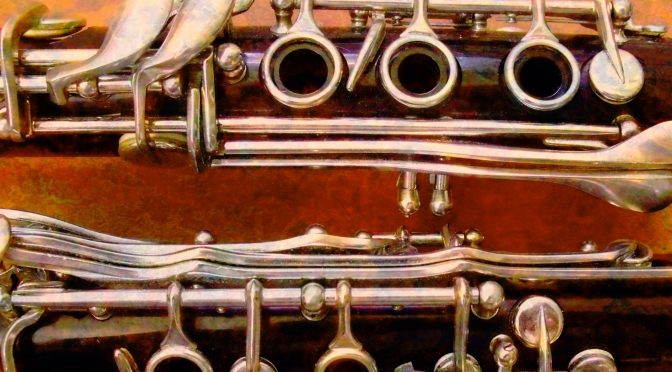
I learned how to play the clarinet when I was around 13 years old. Wait, let me rephrase that. I started learning how to play the clarinet when I was around 13 years old. (It took a while.)

Have you ever heard a beginning clarinet student play that instrument?  Wow, you can make a lot of bad noise when starting out. I feel sorry for what my parents had to endure when I practiced at home in my bedroom. Day after day, I practiced. Getting a little better over time, but boy did it take a while to get beyond just making noise.

Learning an instrument starts out as a technical exercise. You even have to learn how to place your mouth on the instrument right. (It is not as obvious as you might think.) You have to learn how to place your fingers on the instrument in the right way. And in creating the various notes, you have to press your fingers down or lift them up in the right order or it won’t work right. It is a bit complex.

And then there is the music theory you have to learn also. What is an eighth note, a half note, a rest? What is staccatto? Tremolo? On and on.

You spend a long time learning enough of the technical stuff before you really get to what is interesting: the music. Eventually, you have learned enough to discover the real beauty of the art is not in all the technical stuff of where you put your fingers and how you read sheet music, but rather it is how you make something beautiful with your instrument.

There are some similarities with photography. Granted, you can pick up your instrument, in this case a camera, and immediately start taking pictures (and it’s sure not that way with a clarinet). The more you learn the technical stuff, you can produce even better art with your camera because you have more ability to be creative with your instrument. You can go beyond the limitations imposed by using a camera in its fully automatic modes.

As you dig deeper into learning the technical parts of photography, it is important to remember the real objective is to get beyond the technical to explore the art of photography more fully. Learn the technical, but don’t get hung up on the technical. Learn the rules but don’t be afraid to play with the rules, bend the rules, maybe even break the rules if needed. Stay focused on creating art.

Art is more of an emotional thing than a technical thing. The technical stuff is really just a necessary means to an end.  The fun really begins once you have learned your instrument and you start creating beautiful art with it. That is true whether it is a clarinet or a camera.

Music has many different genres, and so does photography.  I encourage you to explore different genres of photography. Try new things. Explore. Experiment. Fail. Experiment some more. Learn from your mistakes. Discover what you like. Discover what you dislike. Eventually find your passion in the art.  Find what you love, and do that. Find a way to express YOUR view of the world through your images. Don’t just copy others. The world loves a creative artist who expresses their art in ways they have not seen before.

Create something beautiful. Be an artist.

Happy Picture Taking

Kevin


Share

Managing ISO

You may already know about the ISO setting on your camera.  This setting controls the camera’s sensitivity to light.  The higher the number, the more sensitive it is to light.  For hand-held photography, generally you can shoot at lower ISO settings in bright scenes, and you will have to move to higher ISO values in lower light.

There is a tradeoff when you move to higher ISO values.  The image becomes more “grainy” due to a phenomena called “digital noise” that degrades the photo.   Cameras are getting better all the time with abilities to go to very high ISO values.  Generally you want to avoid the highest ISO settings on any camera, and stay as low as possible.  Built-in high ISO noise reduction and features to reduce noise in programs like Adobe Lightroom can help, but you are still better off not having the ISO go higher than it needs to be.

How high does it “need” to be?  The answer lies with the shutter speed.  If you are shooting hand-held, the shutter speed needs to be fast enough to minimize motion blur caused by hand movement.  A very general rule of thumb is to keep the shutter speed at 1/(focal length), so it depends on the focal length of your lens.  The longer the focal length, the faster the minimum shutter speed should be.   Other factors like sensor crop factor and whether you have Image Stabilization/Vibration Reduction also affect that, but the general rule is a good starting point.

The other reason you might need a higher ISO to achieve a faster shutter speed is if you are trying to freeze motion of the subject in the photo, as in sports or active wildlife.

As you move to higher ISO values, you can shoot at faster shutter speeds.  If you need the shutter speed to be twice as fast, simply double the ISO.

Assuming you  are just trying to minimize the effect of hand motion blur, there are two ways you can deal with the problem.  Move to a sufficiently fast shutter speed using the rule above, increasing the ISO as needed, OR put the camera on a tripod.  If the camera is on a tripod, you don’t need to move to a high ISO to minimize hand vibration. That shutter speed rule ONLY applies when shooting hand-held.

Auto ISO

Many cameras offer a feature that can help you get sharper hand-held shots.  Canon and Nikon deal with it a little differently so I’ll explain both approaches.

Canon  has a special ISO setting called “Auto”.  When you use Auto ISO while shooting in Av (Aperture Priority) Mode, the camera takes control of the ISO to try to ensure the shutter speed is fast enough to minimize blur caused by hand vibration.   So, if you increase the lens focal length, you’ll see the camera automatically increase the ISO.  Or in Tv (Shutter Priority) Mode, the camera ensures the ISO is high enough to enable you to use the shutter speed you have chosen.  Or in Manual Mode, you can set the shutter speed and aperture to whatever you want and the camera will try to pick an ISO that enables you to use those specific settings.  Auto ISO is pretty handy.  On my Canon EOS 6D, it does a pretty good job with Auto ISO. But note that this is primarily used when doing hand-held photography.  When shooting on a tripod, you don’t need to follow that hand-held shutter speed rule and you don’t necessarily need to raise the ISO to higher values because the camera is already stable because of the tripod.  (Note: turn off the Image Stabilizer when shooting from a tripod.)

ISO Sensitivity Auto Control

Nikon doesn’t have “Auto ISO” but has something similar.  Nikons have ISO Sensitivity Auto Control.  You have to configure its settings through the menu.  The basic idea is that the camera lets you pick the ISO and if the camera detects that you have made a poor ISO choice for hand-held photography, it automatically intervenes and changes the ISO to a more appropriate value.  There are various parameters you can control from the menu, so you’ll want to check it out.  Again, this isn’t necessarily appropriate if you are shooting from a tripod.

I encourage you to explore these options and become familiar with how they work.  As with all tools, they have a time and place where they come in handy.

Happy Picture Taking!

Kevin Gourley

Share

The Artist’s Crisis

I have so many photographer friends.  Many are hobbyists, and others are professionals, either part-time or full-time.  Photography used to be my hobby, back when I did it simply because I loved photography.  I think that’s why most photographers DO photography, simply a matter of love.

I think most artists are fragile.  Okay, sure some artists are arrogant jerks (I only say that because I have known a few.) But for the most  part, artists are sweet beautiful people who see their “art” as an extension of themselves.  They/we want other people to love our art because we feel better about ourselves.  I might be wrong on that in some cases, but for the most part, all you have to do to make an artist smile is to tell them you love their art.  They/we bask in the adoration.  “Ahhh I am loved.” 🙂

And if you are a Facebook user, tell me… when you post a photograph you’re really proud of, do you keep checking to see how many “likes” you’ve earned?

More “Likes” = “I must be a better photographer”

Would an artist keep doing their art if they only got criticism?  “Your art sucks.” doesn’t usually serve as a good motivator.   In fact, if several people tell you your art is terrible, you probably will be tempted to throw your camera off a cliff, or maybe jump along with it. (But don’t do that.)

I am a big believer that every artist should, to some extent, resist this yearning to be affirmed, and instead pursue their art for themselves.  Do it because YOU love it.  Excel because YOU love what you are doing.  Challenge yourself because YOU want to create even better art.   Maybe don’t even do your art the way others do it.  Be creative. Be different. Be you. You are the WORLD EXPERT on being you! So be good at it!

I think when we tune into that creative force within us, there is something really cool happening.  Now I don’t want to get all “spiritual” on you (and some of you might not agree with me on this anyway) but I think our creative nature is something given to us by God. I see God as a loving force that is in the business of “creating” and we are created in God’s image, so we also are creative beings.  At least that’s the way I see it.  Regardless of how you see it, I think you’d agree that there is something special and unique about us humans… we seem to be built to create art and music.  I love it when I see someone create beautiful art, expressing that creative force within themselves.

The Curse of “Going Pro”

I am a full time pro photographer.   I have to admit, I wonder sometimes why I did this.  I have been in business for myself for almost 20 years, so I am somewhat comfortable with the unpredictable income varying from month to month.  I LOVE working for myself.  Well, for the most part.  Ok, parts of it I hate.

Being  a pro photographer is not as “glamorous” as some people think it is.  I mean I am not always out doing some amazing photography in the mountains of Colorado or photographing a beautiful model.  I am also the janitor.  Yes that is my hand carrying out the garbage from my studio.  That is a better summary of daily life, just doing what needs to be done because it is my job, not just my hobby.  And then there is the book keeping.  Thank God my wife handles that.  I am grateful for that. I hope she never screws up because I can’t fire her.

I think the hardest thing about doing photography professionally, though, is the fact that as soon as you accept money for your service of photography there is an expectation that you will do a good job.  You are no longer in the business of pleasing yourself.  You have to please someone else.

Pleasing someone else is kind of tricky.  It is subjective. You might create a photograph that you think is absolutely fantastic.  The lighting is just absolutely perfect. Then the client says, they don’t like their smile in that shot.  But don’t they see how beautiful the light is??  Check out that bokeh. Isn’t that perfect??  Nope, the smile is all wrong.  Well darn.

The challenge is very real.  You are placing yourself in the position of creating something that you need someone else to love.   In this mission, you are BOUND TO EVENTUALLY FAIL at some point.  And then the temptation is to run over to that cliff with your camera and jump OR you decide you want to be a plumber.  That’s it.  You’ll become a plumber. They are paid pretty well.  And no one can argue with you when you show them you fixed their stopped drain. It’s working now.  That’s not a subjective thing.  It is either fixed or it isn’t.  Yep, I am going to be a plumber.

Or maybe you just had a bad day and you just blew it.  No excuses.  You just didn’t do a good job and you know it.  Again that is BOUND TO HAPPEN SOMETIME.   You want to minimize this stuff from happening, but it happens.  Most photographers won’t necessarily admit this can happen but it does.  Now you are scrambling to see if you can somehow fix the shots in Lightroom or some Herculean effort in Photoshop.

I guess  am just writing this to say, if you hit an “artist’s crisis” like this, don’t give up.  You are not a failure.  Just try to recover and keep moving forward.   You are not the only person this has happened to.

I personally know of photographers who I think are OUTSTANDING photographers who have faced this crisis.

If you need a hug.  Drop by and I’ll give you a hug.

Whatever you do, don’t give up.

I love you artist types.  Keep making art.

Kevin Gourley



Share

Alien Skin Software: Exposure X2

First, I have to make a clear confession.  I am a proficient Adobe Lightroom user, and don’t have much experience with Exposure X2 from Alien Skin Software.  BUT I just took Exposure X2 out for a “test drive” and thought it was worthy of pointing out this nifty program to you all.   Yes, Exposure X2 can be used as a plugin from Lightroom, but it also can be used as a standalone program.

If you have experience with Adobe Lightroom, the first thing that you’ll notice is the incredible similarity of much of the user interface. With some portions of the program, you’ll almost feel like you are using Lightroom!  In spite of it feeling sort of like Lightroom, it’s definitely not Lightroom. Exposure X2 has an impressive set of photo adjustment tools built in.

You’ll quickly notice that there are not different “modules” for managing and organizing that are separate from the developing and editing of the images.  Unlike in Lightroom, it is all kept together in one interface.  That has some advantages.  Also, as soon as you start using Exposure X2, you might notice that you immediately have access to ALL of the images on your computer.  There is no need to first “import” them. They are just there ready to be edited when you open a folder.

When you do any editing, remember that Exposure X2 still does “non-destructive editing”, meaning that it doesn’t really change the image until you export it.  (Believe me, thats a good thing.) And it works handily with RAW and other image formats. As you look over the editing capabilities, you will see a range of additional tools not found in Lightroom, such as overlays of really cool borders, light effects such as flames and flare, infrared simulation, simulated bokeh adjustments, and a variety of textures.

All of these additional built-in editing tools make Exposure X2 still useful as a plugin in Lightroom even if you don’t use it as a full Lightroom replacement.  But keep in mind it is indeed a fully capable standalone program.  Just note that if you were to make a complete transition from Lightroom to only use Exposure X2, Exposure X2 will not automatically know about the edits that reside within the Lightroom catalog.  So even though the interfaces look similar, it does not mean it’s an instant switch to quit using Lightroom and switch fully over to Exposure X2.

As I mentioned, Exposure X2 is capable of browsing any drive or folder to view and edit images without having to use any sort of ‘import’ operation.  Its response is pretty snappy when you browse to a folder it hasn’t viewed before. Exposure X2 appears to be a well designed program, not just in its user interface, but “under the hood” with fast efficient processing of images, which you really need when you work with thousands of images.

OH and one last point. You can also use Exposure X2 as a plugin from Photoshop!  That is really cool because if you are proficient in Photoshop, you can use layers to mask in Exposure X2 effects in portions of an image or mix and blend the effects, further enhancing the value of using Exposure X2 as a handy tool in your bag of tricks along with other plugins and tools.

Check out Alien Skin Software and see if their software or plugins might be a fit for your photography workflow!

http://www.AlienSkin.com


P.S.  My students get a generous 10% OFF Alien Skin Software!  Thank you Alien Skin!

Happy Photo Editing!

Kevin Gourley

Share