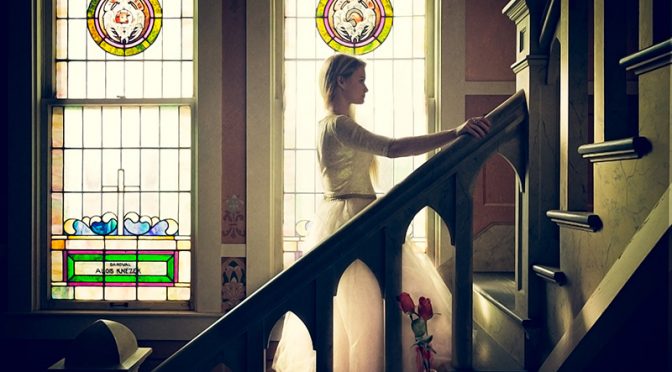
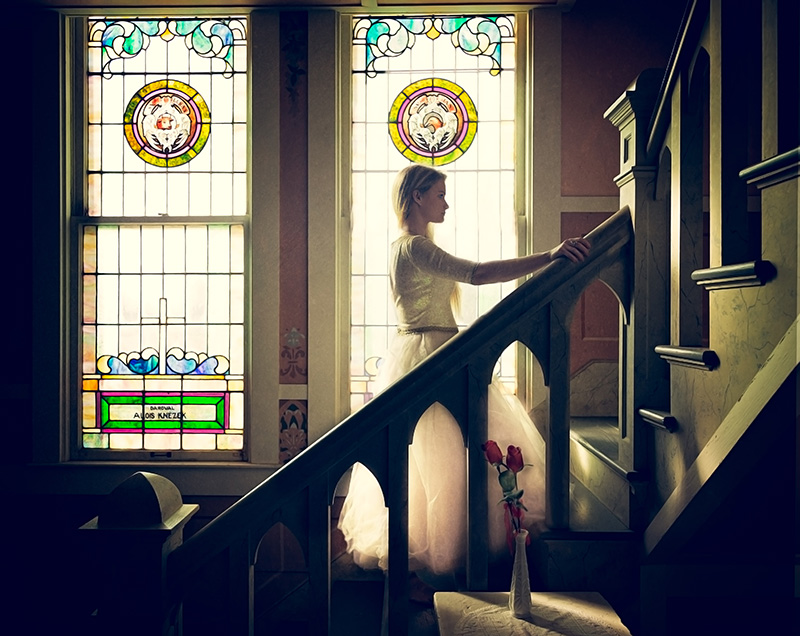
With a few Photoshop edits, you can alter the appearance of an image, changing the color, brightness, as needed. I just wanted to mention that, just in case you hadn’t thought of that!
For this image, it was originally shot against a green backdrop.
For this quick example, I intentionally did not do any super dramatic changes, like totally substituting a different background. These are just some super quick edits all made within about 3 minutes max.
Here are the steps I used in Photoshop:
(You’ll have to know a bit of Photoshop terminology for this to really make sense. 🙂 )
I used the menu item Image -> Adjustments -> Replace Color command. Then after I used the eyedropper to select the green background I simply shifted the Hue and Luminance sliders until I achieved the color I wanted.
I just did a few quick edits to remove one of the catch lights in her eyes using the Brush tool, and then some quick Clone Stamp edits to clean up a few hairs, followed by a tiny amount of small cleanup of very minor blemishes using the Healing Brush (her skin is amazing anyway though!).
Finally I created an Adjustment Layer (choose any type, really) and change its Blend Mode to Multiply. Then I used a black brush on the Layer Mask to removed the effect of that layer mostly in around the top half of her body to provide a nice vignette. That’s all!
I am considering what classes to offer next! I recently have provided several Photography 101 classes and now I want to offer in May and June what YOU want me to offer most, and what will best meet YOUR needs! So if you are ready to take the next step and learn more, please tell me what you are ready to sign up for, and if I get enough responses, I’ll add the class(es)!
Options Include:
Adobe Photoshop Workshop
Adobe Lightroom Workshop
Real Estate Photography Workshop
Flash/Speedlight Clinic
(Both times I added this recently they sold out immediately – and several of you are interested in another class, but we need to pick a date that works!)
Photography – Mastering the Fundamentals (sequel to Photography 101)
Expanding Your Creativity (a new and fun class!)
Photowalks Around Town
Private Instruction
If any of these are of interest to you and you want me to add the class in May/June, this is your chance to help influence my decision!
I love landscape and nature photography! Beyond mastery of your camera settings such as exposure modes, aperture, depth of field, shutter speeds, ISO, focal lengths, etc. there are three primary factors that will impact your landscape and nature photographs:
Location – Seek out locations that will potentially yield great results for nature and landscape photographs. Do your research! There are tons of resources online to give you good suggestions on locations, national and state parks, etc. for great photographs. Participating in a destination photography workshop is another great way to learn about the right locations to visit, at the right times of day. Plus, if you are looking for wildlife, you really need to do research on the best places to find the wildlife. Ask the locals! Ask park rangers!
Timing – Your choice of time of year and time of day has a huge impact on your nature and landscape photographs. You can’t really modify the light on a mountain to make it look perfect. All you can do is plan to be at the right spot at the right time, with the greatest possibility of having great light. That might mean showing up very early in the morning or late in the day, or that might mean coming back at a different time of the year. There is a great app for planning the timing for the best light in any location. It is called The Photographer’s Ephemeris. It’s pretty cool. You can use their app to put a “pin” on a map and then have it show you exactly the sun and moon light angles and exact location of sunrise/sunset and moonrise/moonset and the timing for all that. You can use the app to precisely plan the best day and time and location for your perfect sunrise or sunset.
Luck – Despite all your planning, part of this boils down to just pure luck. You can choose the perfect location and the perfect time, but you can’t choose what the weather and atmospheric conditions will be at that time. And if you are looking for wildlife, you can’t be sure the wildlife will actually be there, even if the local people all say that is the perfect spot for viewing wildlife. You an get up early to photograph a sunrise, but you won’t really know for sure if the sunrise will be spectacular or covered up by a cloud bank. Ultimately there is a certain amount of luck involved in being at the right place at the right time. All you can do is try to place yourself in the optimal locations at the right times to increase your chances of success.
Here are a few photos along with some other tips:
Choose the right time of year for fall colors.
Sometimes converting an image to black & white can make the scene even more dramatic. Try to have a foreground with leading lines that draw your eyes deeper into the photograph.
Try to place something in the foreground, to add more interest to the shot.
Use “framing” to have elements in the foreground naturally frame a key subject in a landscape.
Shoot upwards sometimes. Use wide angle lenses to take in a wider view of a scene. Shoot at a really high f/stop (like f/22 in this shot) to create that starburst effect.
Reflections create nice symmetry.
Sunrises are always a gamble. Don’t let the prospects of a cloudy morning scare you away. You actually want clouds in the shot. A sunrise can turn out to be pretty boring if there isn’t a cloud in the sky.
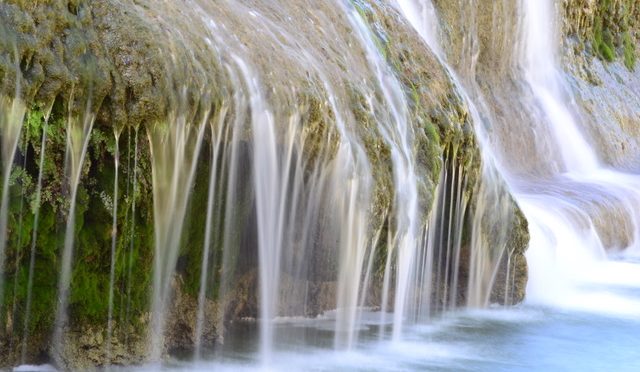
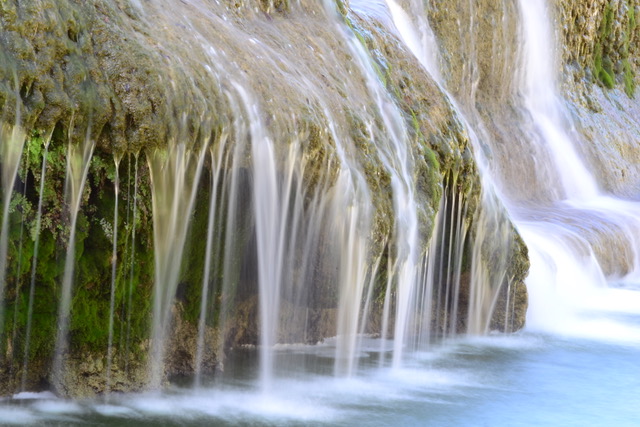
If you want to capture soft flowing waterfalls, use a slower shutter speed.
Be ready to capture an unexpected moment with wildlife.
Ultra-wide angle lenses are always handy for some wide scenic vistas our mountain ranges. When shooting lakes, try to feature the reflections in the water.
Bad weather can be dangerous, but don’t put away your camera!
Early morning light on mountains provides such a beautiful enhancement to any mountain shot.
If the atmospheric conditions are creating beautiful clouds, make sure you feature the clouds in some of your photos.
Enjoy and Appreciate
One of the things I love the most about nature and landscape photography isn’t even the photography itself. It is the fact that it is a wonderful excuse to just be out there in the midst of this beautiful and amazing world.
Generally speaking, you want to shoot at the lowest ISO you CAN for any given shot. That does not mean you should never shoot at high ISO values though. Just only do that when you really need to.
When do you need to shoot at higher ISO values? Really there is only one main reason, and that is to get to higher shutter speed values. Sometimes you might need to go to higher shutter speed values just to ensure you eliminate any negative effects due to hand movement/vibration when hand-holding your camera. And the other reason for higher shutter speeds is to freeze movement of elements within the photograph, like a subject that is moving.
If you are finding your shutter speeds aren’t fast enough, then you only have three options really. Increase the light, open up the aperture more, or increase the ISO. If you can’t increase the light, then that narrows down the options. If you open up the aperture, that will allow you to shoot at faster shutter speeds but that also affects the depth of field. If that is permissible, then opt for that solution first. But then if that still doesn’t get your shutter speeds in the range you are needing, it is time to bump up the ISO. Many of the latest generation cameras go to very high ISO values. Generally speaking, you still want to avoid the highest ISO settings on most cameras.
In this photo shoot I did with a couple of models, we were spraying water and I wanted to capture very high shutter speeds. It was late in the afternoon, and the only viable option was to take the ISO all the way up to 12,800! I rarely (actually never) shoot portraits at ISO 12,800 but I made an exception for this.
If digital noise becomes a problem, remember you can apply noise reduction using Adobe Lightroom or Photoshop, so the digital noise isn’t necessarily a deal killer at all. The bottom line is that your camera has those higher ISO capabilities for a reason. Use them if you have to, but ONLY if you have to!
Experiment with light when you create portraits. Especially take note of ways you can make the photograph more interesting by more dramatic use of light and shadow.
Sometimes you might even choose to place the main light (key light) in a position where it only adds light on a portion of a face, and allow other portions of the subject’s face and body to fall off into shadow. This is a more dramatic style of lighting that often leads to nice results. The viewer’s eye will be drawn to the light areas of the image. It might not really matter that other portions of the subject fade away in the shadows.
Also, due to a phenomenon called the “inverse square law” of light you can get a more dramatic falloff of the light by positioning the light closer to the subject. The inverse square law says that the light drops off in a very predictable way. Light decreases as in inverse of the square of the distance from the light source. If that doesn’t mean anything to you, just know the light drops off more quickly from one side of the subject to the other when the light is positioned closer to the subject.
TOO LATE! SOMEONE SIGNED UP TO FILL THIS VACANT SPACE IN THE CLASS. (But let us know if you’d like to be placed on a waiting list in case there is a cancellation.)
It is very rare to be able to get into this workshop at this late date, especially since lodging options are also sold out by now. BUT if you sign up ASAP you can take the available spot and we have a space available for you at the lodge. We just can’t hold this space for very long.
To attend the workshop, you would need to plan on arriving on July 7th and departing on July 12th. The workshop is four full days of photography in one of the nation’s most beautiful national parks. Plus we have two pre-trip meetings to prepare you for the trip, providing information about our adventures and how to plan your travel, and a session on photography tips to get better photographs while we are up there. I also offer an option where you can choose an add-on option with an online teaching session where I show my tips how to best edit your photographs from the trip using Adobe Lightroom.
We’d love to have YOU in our next group photo there in Rocky Mountain National Park!
The following are a few photographs from our travels there.
We stay at a wonderful little lodge right on the banks of Fall River, just 2 miles outside the park.
There are so many majestic views within the park.
We’ll experience a few sunrises.
And a few waterfalls.
And moose.
And wildflowers.
And marmots.
And possibly big horn sheep.
And you’ll be experiencing the trip with others who love to photograph nature.
While the wildlife look down over you and watch.
There are so many beautiful rivers, cascades, and waterfalls in the park!
We’ll do some hiking together.
And we’ll do a cookout on Fall River (weather permitting).
And more sunrises.
And more wildflowers, butterflies, moths, etc.
Imagine your happy face added to this group shot.
There is nothing like watching a sunrise from the side of a mountain as the park awakens to a new day.
Ducks!
Happy Photographers!
Crazy photographers up very early to photograph sunrise!
Elk in the early morning light (one of the reasons we get up early)!
Long’s Peak towers over the park.
More happy photographers
Fog in the mountains. So peaceful!
More big horn sheep!
Sometimes when the weather conditions are just right, the layers of mountains and clouds can be so beautiful!
More wildlife (confession: I love moose!)
More cascades. This is Copeland Falls.
You need to sign up so you can experience all this!
The wildlife are waiting for you.
The mountains are calling you.
The trails are waiting for you.
I hope you will join us. It is a wonderful photographic adventure!
If you can’t but happen to know a photographer who might be interested, PLEASE PASS THIS ALONG TO THEM. They will thank you!
Several of our participants have come back a 2nd or 3rd time!
Here are what other photographers have said about this experience:
“The natural beauty of RMNP was enhanced by Kevin’s knowledge of the park and locations that were custom picked for great photographic shots. Kevin’s calm, patient and knowledgeable teaching style meant that everyone, at whatever level they were at, felt comfortable asking questions, making mistakes, learning from them and then getting immeasurably better pictures as a result. The improvement in my photography from Day 1 to Day 4 was unbelievable. I came thinking the auto settings on my camera really took better pictures than I did, and I left seeing and believing that the pictures I now understood how to take were vastly superior to anything the camera could capture in auto mode. It was a 5 star experience from beginning to end.“
“This is a workshop you can’t afford to miss! I came to the workshop with a goal of never using Auto settings again… I achieved that and more. Kevin is such a great teacher and is able to work with photographers of all levels. He made everyone comfortable, I am from Virginia and did not know anyone in the group (as were several others) by the end of the work shop I had made a group of new friends! We were able to get so many landscape and wildlife pictures. The whole experience was amazing. I’m ready to sign up for the next workshop! Thank you Kevin” – Barb
“The Rocky Mountain Summer Photography Workshop was an amazing experience! The success of the workshop begins with the organization and preparation of the instructor. Kevin and Gail were superbly organized and prepared! It was a treat to be lead to the best spots at the optimum time of the day to photograph the spectacular beauty and wildlife in the park. They demonstrated great flexibility and adaptability in meeting the needs of the group with the ever changing clouds, weather, and wildlife. It was also an incredible learning experience having a photography professional available to coach and instruct on the best methods for creatively composing a scene, capturing stunning images, and the correct use of a wide range of photographic equipment. Not only can I wholeheartedly recommend this workshop, but I’m already scheduled for a Rocky Mountain Fall Photography Workshop with Kevin!”
Sometimes I am asked if an image was edited with Adobe Photoshop. My answer is almost always yes, at least to some degree. To be well-rounded in your photographic skills these days, it is important to sharpen your camera skills, management of light, AND editing your images on the computer.
I work with all of my images using Adobe Lightroom, and then for some of those images, I take them a step further and use Adobe Photoshop to enhance them. I also use a variety of great plugins from companies like Topaz Labs, Google Nik Software, Alien Skin Software, and others.
In this photograph, I’ll break down the main sections where I edited the image using various tools. My model’s name is Vanessa. She was absolutely wonderful to work with.
Here are the areas that were modified from the original image.
First I tweaked the overall image light levels just a little bit in Adobe Lightroom. My camera exposure settings were pretty much perfect already, so I didn’t have to adjust the image very much.
A. In these areas, I made some Photoshop edits. I added the fake ball of light using the Photoshop Filter->Render->Lens Flare option. Then there was a clothes pin holding the fabric that I had to remove with the Photoshop Clone Stamp tool and the Healing Brush.
B. I did a little smoothing of her skin using Nik Color Efex Pro‘s Dynamic Skin Softener Tool. Vanessa didn’t really need much smoothing because her complexion was already wonderful.
C. I used my Topaz Glow plugin from Topaz Labs just to enhance Vanessa’s hair and the fabric ever so slightly. I also used Topaz Glow to modify the ball of light to have a more unusual look.
D. I dropped in a different background using Photoshop Layers and Layer Masks, just to further mix things up and just to give the photo a bit different look from the original studio shot.
Here is the original photo, as shot in my studio (note the clothes pin)
😉
There are an infinite number of options for how you might edit any photograph. This is really a lot of fun, once you learn how to use Adobe Lightroom and Photoshop and explore some of the many plugins.
I encourage you to not get “stuck” in just one aspect of photography. Explore your creativity. Challenge yourself technically. Experiment with different lighting techniques. Improve your photo editing skills. Dare to liberate yourself to create art, not just photographs.
I went to the Houston Art Car Parade this past weekend. I brought all my DSLR camera gear with me to Houston but when I woke up Saturday morning, I decided I didn’t want to bother with carrying my camera. So, with a little hesitance, I left my DSLR behind and just took my iphone as my only camera. I just wanted to enjoy the event, and fully experience the vehicles rather than focusing all my attention on photographing the vehicles.
Sometimes “photographing an event” can be quite different from “experiencing an event.” I just wanted to experience it and have fun. (Maybe it is because I take so many photos that, for me, NOT taking photographs can be my chance to just enjoy and relax.)
Therefore, everything I post here are just my iphone snapshots. The purpose of the post is not about my photography of the event. Rather, I wanted to talk about the experience, and a few insights gained.
I 100% believe it is important for all artists to observe and explore various forms of art, not just “their” art. Photographers should study painting, sculpting, music, dance, etc. Take the time to SEE how other artists pursue the expression of their art.
One thing I also believe about photography is that we need to learn the technical stuff only to open the door to our creativity, but do NOT stay stuck in the technical stuff. You will find all sorts of websites that will tell you to buy they highest quality gear, cameras with the biggest number of megapixels etc. and they’ll obsess about the technical aspects as if that is what makes good art. While the tools you choose are indeed important, that is not the whole story. You can go out and by a super sharp $2000 lens and yes your photos may end up being a bit sharper, but that does not mean your images will necessarily any be better artistically.
I urge you to liberate yourself and think more broadly about your photography as ART, and open your mind and eyes to ways you might challenge yourself artistically to express your art in new and fun ways.
I will soon be offering a totally different type of photography class…
This class will help you photograph the world differently, with new eyes, and new means of expression, and challenge you to put into practice what you learn and discover in class and then come back and share your art with the group. Plus you will have a chance to see what the other artist/photographers came up with.
If you want to get better at photography, learn the technical fundamentals but absolutely do not stop there. That can get boring after a while! Also learn to be proficient at tools like Adobe Lightroom and Photoshop, but then take the next step! Challenge yourself artistically.
Let me know if you’d be interested in participating in this new class, and I will announce more details soon. You can contact me using my website contact form, or if you know my email address, just send me an email, or post a comment at the bottom of this blog post.
Now, back to the Art Car Parade…
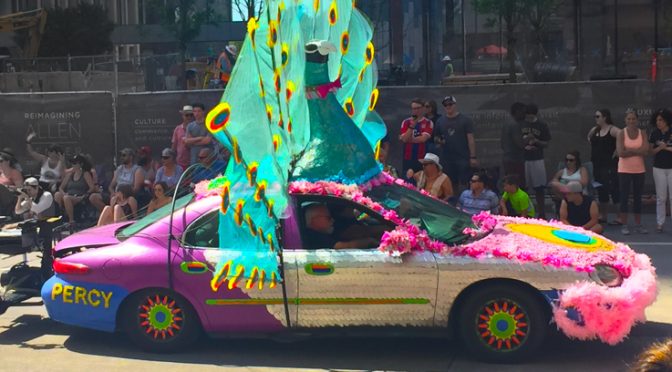
Here are some of my iphone snapshots from the art car parade. I loved the wild and crazy things people did to their cars, or their vision that went beyond just modifying a car, and instead create a whole new type of vehicle. It was a lot of fun, and I found myself inspired and entertained for several hours.
Could you imagine driving this through downtown Austin?
Some pretty wild designs:
This one, I really liked!
And then there was this van completely covered in old cameras.
Another wild vehicle.
What do you do if your hobby is model railroading, and you decide to enter the Art Car Parade? Mount your model railroad on top of your car, of course.
Yaba Daba Doo.
Must’ve used a LOT of glue for this.
Pretty cool.
I really liked this one. Car converted into a sardine can.
You guessed it, the driver was dressed as a sardine.
More fun wild stuff.
Yes, I LOVED this one. Extra credit for thinking outside the box. Or I guess he stayed in the box.
What do you love to photograph the most? I enjoy photographing nature and cityscapes.
What is one thing you have learned that has improved your photography? I’ve learned that time and patience is key to capturing the right shot.
Advice you’d give to others wanting to grow in their photography skills: My best advice is to take a lot of photos, then pare them down to your favorite shots and study them. Ask yourself what it is about the photos you like. Is it the lighting? the mood? emotions? color? symmetry? This will help you define your style. Also take note of the time of day you took the photos, as well as weather conditions, and the exposure you used, which will help you to hone your skills. And if you don’t know how to do something, look it up. Or better, attend one of Kevin’s workshops. I learned a great deal in the Photography 101 class, including how to take a waterfall shot!
What do you love to photograph the most? I have actually given this question a lot of thought lately. That’s because over the years, people have frequently asked me this question, and I found myself giving different answers each time (depending upon what I had most recently photographed). Now that I’ve given it some thought, I realize that my favorite images are the ones that involved fun experiences. To elaborate, my philosophy is that photography has less to do with the final image and more to do about the impact of the art itself (travel with family, spending time with friends, immersion in nature, teaching my kids, noticing beautiful things in the world that are otherwise overlooked, escape from reality, showing people how strong / powerful / attractive they really are – I could go on but I’ll stop there).
What is one thing you have learned that has improved your photography? Short answer: Knowing the Why. Long Answer: When I was a newbie, I took an individual photography tour in Paris while I was there for a family trip. The French photographer taught me to study not only other people’s photographs but also paintings; she took me to an art store in Paris and walked around with me. She asked me to point out the pieces I liked, and we discussed what drew me to those pieces in particular. Some people may have been put out to spend time looking at other people’s art instead of practicing my own photography with this tour guide. But, my approach to photography changed that day, and the time spent studying other people’s art was ultimately much more valuable than the same amount of time taking my own photos. Now, I look at other people’s photos and other forms of art – I mean I reallylook at them. It’s easy to breeze through images, because we are exposed to so many images, especially through social media. However, by being cognizant of what I like and (most importantly) why I like it often leads my photos to have a reason behind it. For example, I learned that I enjoy Vermeer, and I try to mimic his lighting. I have found that my most successful images have been ones that were purposeful based on what compositions, color, lighting, and themes that I already know I like.
Advice you’d give to others wanting to grow in their photography skills: My advice is to ask for feedback and instruction from experienced photographers like Kevin Gourley. Continue taking classes and never stop learning!
I am including this particular picture because it is an example of “knowing the why”. I planned out the dress, the lighting (in an attempt to mimic Vermeer), the colors, and the composition prior to photographing the image. I even drew it out on a scratch pad before the shoot. Because I knew what I was going for, the image did not take long to capture, and in my opinion, it worked because I knew exactly what and why I wanted it this way. By the way, I have plenty of images that (in my opinion) didn’t “work”, because I didn’t properly plan.
Kevin Gourley Photography Workshops, Austin, TX – Austin Photography Classes