Thanksgiving… For YOU

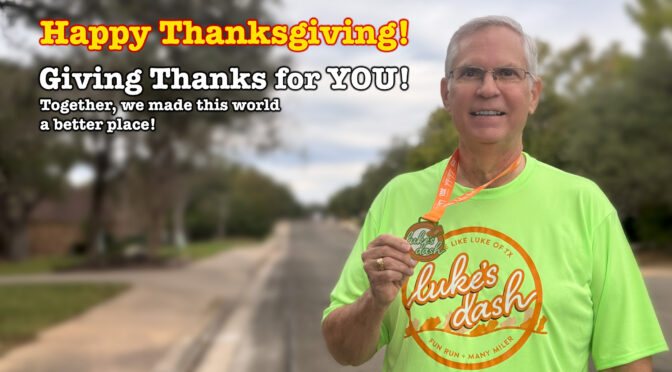
This Thanksgiving, I am overwhelmed with gratitude, and it is all thanks to YOU. This year has been incredible because of your generosity and the life-changing impact it created. While we organized the fundraisers, your contributions fueled everything.

Together, we didn’t just donate—we delivered hope. Because of our joint efforts, you helped:

  • Support families of children facing life-threatening illnesses.
  • Bring the gift of music therapy to children at places like Dell Children’s Hospital.
  • Sustain a retreat center offering spiritual, educational, and recreational renewal.
  • Provide vital support for adolescents and young adults struggling with addiction, depression, and mental health challenges.
  • Sharing opportunities to support efforts bringing Thanksgiving turkey dinners  to families who may need a little extra help this season.

This year we raised a total of $7581
THANK YOU ALL FOR YOUR SUPPORT!

$300 to Mo Ranch in the Texas Hill Country
$3001 to Live Like Luke of Texas
$4030 to Texas Music Project
$250 Value – Silent Auction Donation to Michael James Cotton Foundation
Turkey Dinner Donations – Via Bethany United Methodist Church

Over the years, our photography business has supported so many worthy causes, making a difference in the lives of many people in out community and beyond! It was actually YOUR collective generosity that made the difference. THANK YOU all!

Kevin Gourley

Share

A Celebration of Generosity

Hi friends!

I just had to celebrate what an amazing year this has been so far. As many of you know, I have always considered an important part of my business was to find ways to also make a positive impact in our community. Here are a few organizations my little business has helped.

WOW! I have a particular reason to celebrate this year because we’ve achieved our best year of impact on our community through all of YOUR generosity!

$300 to Mo Ranch in the Texas Hill Country
$3001 to Live LIke Luke of Texas
$4030 to Texas Music Project
$250 Value – Silent Auction Donation to Michael James Cotton Foundation

That’s a total of $7581!
THANK YOU ALL FOR YOUR SUPPORT!


Life-Insights: We have continued to support our “Life-Insights” group that meets (generally on the 1st and 3rd Monday evenings, plus occasional breakfasts)! We have donated the use of my studio space for over 7 years for this wonderful group. All are invited. It’s just a chance to connect with others. It’s my effort in “loving my neighbors” (anyone I encounter in life). 🙂 Check out the program we’re doing this coming Monday November 3rd (click here) about the “Kindness Diaries” documentary.


Here’s a way you can help our less fortunate neighbors who are having a tough time financially, especially these days. This is something my church (Bethany United Methodist Church – Austin) is doing, delivering grocery bags filled with all the ingredients, including a turkey, to make a Thanksgiving dinner. You don’t have to be a church member to be involved in this. You can read more about it here (click here). To participate, you’d need to follow their instructions so all bags have the same items, OR you could actually donate $80 to fund one of these bags.

The need has been so great, even though the original goal was 200 bags, they are now trying to reach 300 bags!

For those who are unable to do the shopping, you can donate $80 and they will do the shopping. Donating online would be the easiest way to be involved. To donate online, go to this web page (click here).
Important – Read these instructions first (because it’s a little confusing):
Scroll to “Other Giving Opportunities” and select the “Thanksgiving Meals” option under the “Missions & Outreach” drop down list, and enter a dollar amount of $80.

IF you donate, let me know! I’d love to know about others who are helping make a positive difference in our community! (And thank you if you DO contribute!)

Share

Kevin’s 100-Mile Challenge – Completed!

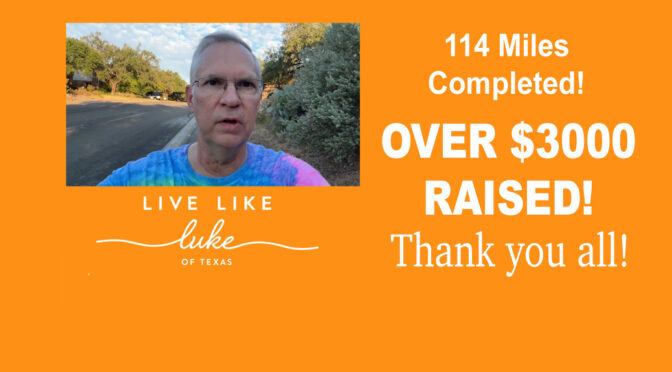
I did it! I reached (AND EXCEEDED!) my 100 Mile goal for the month of September, Childhood Cancer Awareness Month! This walk was for a cause that’s close to my heart: Live Like Luke of Texas. This nonprofit organization is a beacon of hope for families with children facing critical illnesses. 

WE RAISED OVER $3000!!!
THANK YOU ALL SO MUCH!

If you’d like to donate, you still can.
The campaign is officially over though!
CLICK HERE TO MAKE A DONATION: Ignore the other text on the page. Select the “Choose Amount – OTHER” option and type in the dollar amount you are donating or the 14 miles I passed 100!

THANK YOU ALL SO MUCH!!
DONATIONS RECEIVED: $3001

TOTAL MILES I WALKED: 114 miles!

More about the story of Luke: Click Here

Share

Priority 1: Serving You, Serving Community

Central to my photography business has been my devotion to the people I serve and our community.

Destination Adventures

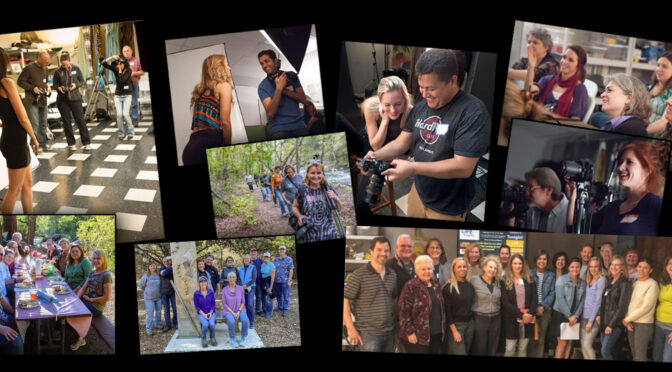
We’ve had some truly memorable experiences over the years with our many adventures in my destination workshops, fantastic mountain adventures in Colorado, hiking the Oachita mountains of Oklahoma, exploring a charming ranch along the North Fork of the Guadalupe River, capturing stunning birds in flight on our Bird Photography Workshop, and more.

Local Classes

And then there have been the many local photography classes where I’ve met many of you over the years. I have enjoyed working with you all so much, and we’ve had some really fun times photographing models in my studio, capturing water droplets, and discovering the wonder of “light painting” techniques, and so much more.

Private Instruction

I’ve enjoyed working with so many of you who chose to meet with me in one-on-one training on a wide range of topics.

Pro Photography

I’ve also really enjoyed the many experiences of working as a full-time pro photographer at my studio, offering headshots, portraits, commercial photography, photo restoration, event photography, etc.

Community Service

Also a priority for me and my business has been to serve the community. I’ve supported a wide range of non-profit organizations in a variety of creative ways, organizations such as the Spina Bifida Association, Make a Wish Foundation, H.E. Butt Foundation, Community First Village, Mobile Loaves and Fishes, The University of Texas MD Anderson Cancer Center, Girl Scounts … over 50 organizations! In fact, a few months ago, we hosted a fundraiser that raised over $4000 for the Texas Music Project!

Also check out my 100 mile walk challenge I am taking on in September to support a nonprofit organization that is a beacon of hope for families with children facing critical illnesses.  CLICK HERE for more info.

Life-Insights

Another way we’ve served our community is a group that I started 7 years ago called Life-Insights with the vision that we can make our world a better place if we intentionally take a little time to get to know more people around us, sharing in this thing we call “life.”  We’ve hosted some amazing programs and classes, all totally FREE to the community, usually meeting on Monday nights.


I hope you to see you in a class soon!

And I really appreciate any referrals, so if you know anyone who wants to learn photography, send them my way. I’m a small operation and don’t spend a big budget on advertising. My focus is on serving you and the community.

Thank you all!
Kevin

By the way…

P.S. I encourage you to attend our FREE Life-Insights session on Monday September 1st at my studio. The topic is “The Secret to Feeling Less Alone“.

P.S. #2 Check out my upcoming classes! We have some great discounts ending soon! Especially check out my Bird Photography Workshop in October. Only a few spaces left! And this may be my final year to offer this fun adventure!!

Recent Client Comments: We’re consistently rated 5 stars! *****

  • “Kevin should be given an award for his lifetime of photography expertise. He’s not only the real deal but also super humble about his excellence and is always willing to go above and beyond to teach anyone who asks to pass on his wealth of knowledge about what’s he’s done for more than 50 years. You need to either book a photography shoot with him or come take his classes – either way, you will walk away with a great deal of satisfaction but also respect for photography (and the photographer himself).”
  • “Kevin was an amazing teacher that balanced the academic foundations of the camera with really practical and actionable insights that I was able to put to use immediately. In just a couple hours of instruction I was able to feel in control of manual settings and have been able to take really high quality photos. I highly recommend for any level of photographer but especially his private classes. Very glad I found his instruction!”
Share

The New Topaz Photo AI 4 is AMAZING!

I have been testing the new Topaz Photo AI 4 and its new “Super Focus” capabilities. The results are astounding!

Check out these before and after shots. The original is a photo I took almost 50 years ago using a Pentax KX camera with Kodachrome 64 slide film. The image is a bit “soft” but running the photo through Topaz Photo AI did an unbelievable job in sharpening the image! See for yourself! This is truly game changing technology!

Original photo:

Original Photo Close Up:

Enhanced with Topaz Photo AI 4 Super Focus:

Or let’s look even closer! Here’s the original image:

And here’s the improved version with Topaz Photo AI 4 Super Focus:
WOW! The software is available at TopazLabs.com!

Share

Left Brain / Right Brain

The left and right sides of the brain work together but each side has some specialized functions.

Left Hemisphere:

  • Language: Primarily responsible for language processing, including speech production, comprehension, and reading.
  • Logic and Analysis: Often associated with logical reasoning, analytical thinking, and mathematical skills.
  • Sequential Processing: Tends to process information in a linear, step-by-step manner.

Right Hemisphere:

  • Spatial Processing: Excellent at spatial awareness, visual-spatial skills (like recognizing faces), and navigation.
  • Intuition and Creativity: Often linked to creativity, imagination, and intuitive thinking.
  • Emotional Processing: Plays a significant role in emotional processing and recognition.
  • Holistic Processing: Tends to process information in a more holistic and intuitive way, focusing on the “big picture.”

When we consider photography, it is most definitely a combination of science and art, and both sides of the brain are involved (well, that’s true with everything).

In terms of how we approach photography, growing our skills, and discovering our unique artistic expression, we should be mindful that we need to master both the art and science aspects.

It is pretty common to confront the technical aspects first. There is so much to learn, involving a bit of math, and numbers, f/stops, shutter speeds, ISO, depth of field, white balance, exposure modes, and so much more. But we are really missing out if we only approach photography from the technical side. You can take a perfectly exposed photograph, all the settings are correct, technically “perfect” yet lacks in much artistic value, certainly no emotional connection between the artist and the viewer of their art.

We must also approach photography from the aspect of its visual artistic expression. How does the photograph you created lead the viewer to experience certain emotions? How does the viewer feel about the photograph? How does the viewer relate to the subject matter? Is it a creative expression of a subject or concept? Does it spur the imagination of the viewer?

Delving into the artistic side of photography goes way beyond f/stops and shutter speeds, and actually is where photography becomes most interesting.

So, I just say all this to remind you that the artistic “side” of photography is every bit as important as the technical side. Strive to grow in both aspects. Pursue unlocking your own unique creativity.

As renowned academic, researcher, and storyteller, Brene Brown says,

“Let me sum up what I’ve learned about creativity from the world of Wholehearted living and loving: “I’m not very creative” doesn’t work. There’s no such thing as creative people and non-creative people. There are only people who use their creativity and people who don’t. Unused creativity doesn’t just disappear. It lives within us until it’s expressed, neglected to death, or suffocated by resentment and fear. The only unique contribution that we will ever make in this world will be born of our creativity. If we want to make meaning, we need to make art. 

Kevin Gourley

P.S. If you get a chance take this class I intermittently offer:

Photography: Finding Your Way – Creativity and Inspiration Workshop

Share

What Exactly Are f/stops?

Sometimes folks have asked why we describe the aperture value in “f/stops” and it seems like weird nomenclature that may not make sense. Actually it makes total sense once you know what it means.

Let’s say you want to know the size of an aperture. We answer with some f/stop number. But exactly how big IS the aperture diameter in millimeters? The f/stop is the answer. “f” is the “focal length”. The aperture size is the focal length divided by the number.

The aperture size (in millimeters) for f/4 is the focal length divided by 4. Let’s say you have a 100mm lens at f/4 What is the actual size of the aperture in millimeters? 100mm/4 = 25mm. How about a 100mm lens at f/2. What is its actual aperture diameter? 100mm/2 =50 mm.

That also explains why longer telephoto lenses that go to lower f/stop values are larger and more expensive. It’s because it takes a larger diameter glass to implement an f/2.8 lens vs an f/4 or f/5.6 lens. If you have a 400mm lens at f/2.8, its aperture diameter would have to be 142.9mm which is quite large (and expensive)! A 50mm lens at f/2.8 would only need to be 17.9mm in diameter.

Now, you know! 🙂

Share

Think Fast and Slow Down

Here’s a piece of advice that may sound contradictory. Depending on the type of photography you are doing, your success will improve if you think fast and slow down.

Think Fast

What do I mean by this? What I really mean is to practice, practice, practice and get to where you just immediately know what settings to use for exposure, focusing, and a zillion other options. There’s a lot to think about, enough to be overwhelming if you are just learning to use your camera.

Once you have used your camera enough you’ll just immediately know what settings to use. You can “think fast” and be ready to capture that next great shot. For wildlife photography, you sometimes have to think fast because that photo opportunity might just be a fleeting moment.

But what about in portraiture? How does this apply? One could argue that you should think slowly, and think through the settings you are going to use. And that’s valid. But in another sense, if you are fully comfortable in adjusting camera settings you can “think fast” in terms of adjusting settings, and instead devote more of your time interacting with the person(s) you are photographing. Portraiture is more about the interaction between the photographer and the subject and the more you can minimize the time spent on distractions about camera settings, the better. Otherwise, the camera sort of “gets in the way” of the photographic process.

Slow Down

Here I was just talking about being fast, and now I am saying you should slow down. What’s with that?? Well, I am just thinking about the impact of digital photography on our ability to take a LOT of photographs in a short period of time. In wildlife photography, for example. I think we are probably all guilty of taking way too many photographs of that bird or animal, as if the real goal is quantity over quality. So, slow down and watch for those really optimal moments where “now” is the time to take that shot. It’s a matter of pacing and critical judgement of how many shots you are going to take.

Being a photographer with a lot of years of experience (a kinder way of saying I am “old”), I started out shooting with film cameras. Back then, with film cameras, you really had no choice but to slow down and make your shot count. There would be NO way, you would shoot 500 photos of an animal with film, so this required us to shoot sparingly. But with digital photography, we could easily come away from a day’s work of shooting wildlife with a thousand or more shots. Remember, we want quality, not quantity. Later on, when going through your 1000+ shots, you’ll pay the price of having the tedious task of picking out the best shot.

Similarly, with portraiture, you are usually looking to create that perfect shot, not a few hundred photos of your subject. S-l-o-w down. Don’t just shoot a bunch of photos. Interact with your subject. Don’t hide behind your camera messing with settings. Be fully “present” in your interaction with person. Do what you can to bring out the best in them, reflecting a bit about their personality, and a genuine smile.

The Blue Heron

I remember back to a time, many years ago where I was leading a workshop and we noticed a blue heron perched on a log on a shoreline of a river. Several in the group were taking picture after picture of the heron as it just sat there, not moving. So they definitely would have won a prize for the greatest quantity of photographs of that heron.

I encouraged them to wait and eventually it would take off, and THAT would be the shot to get. I urged them to have all their settings on the camera ready to go, and especially make sure they have their focusing set where they’d get a sharp shot of the bird, and have an adequate shutter speed to freeze movement of its wings and adequate depth of field through their aperture choice.

I had prefocused on the bird (actually in manual focus mode, so I was ready to go). [This was before the days of the more advanced focusing modes of today.] Anyway, we were all standing there waiting for the heron to take flight, and talking, but I encouraged them all to watch and be ready. Some were tired of keeping the camera pointed at the heron so they had their cameras by their sides. Then, in a sudden burst of movement, the heron raised its wings and took off. In that brief moment, I swung my camera up and fired. All my camera settings were ready. In that sudden moment of activity, I was ready and I got the shot, while everyone else was scrambling to get their cameras pointed at the bird and focusing and making adjustments where there was NO opportunity to make adjustments. The thinking had to all be done prior to the bird taking flight. So this is just an example of thinking fast and then getting the shot. I didn’t need a hundred shots of that heron just sitting on the log. I slowed down and just waited for the ONE shot I wanted.

Practice

If you are new to photography, I encourage you to know your camera and practice using it in various settings. Even practice the process of quickly changing your camera settings. You will find there are moments where your speed in making setting changes will mean the difference of “getting the shot” or “missing the shot.”

Most Important Component of a Camera

That great photographer, Ansel Adams, once said “The single most important component of a camera is the twelve inches behind it!” That is so VERY true. We are tempted to think if we just bought a more expensive camera, all our photographs will be better. What is more important is YOU and how well you know your camera. Improve your skills, and your photographs will improve.

I Can Help

I offer all kinds of classes to help you with your photography, plus I have a lot of students choosing to go with my private instruction where we can focus our discussion on your specific needs at timeframes that best fit your schedule.

Happy Picture Taking!
Kevin Gourley

Share

Learn to Ask the Right Questions

I was just thinking about some of the many lessons I’ve learned in my years as a photographer. One thing I have learned is to be particularly careful in making sure I am asking the right questions.

We always see tons of ads by all the various companies who make cameras, and lenses, and other gear. Of course, the photos used in the ads are usually amazing, and the implication is that if you buy their camera or lens or whatever, your photos will suddenly be wonderful. Or, you might get the feeling “if I just had more megapixels, my photos would be so much better.” Or, if you just purchased this brand of lighting, all your portraits will be as good as this shot of this gorgeous professional model.

We all can fall into this trap. I have noticed on so many social media posts or photography blogs or forums, someone will post this amazing photo, and people will immediately ask “what camera did you use?” or “what lens did you use?” Or maybe they’ll ask what shutter speed, aperture, and ISO was used.

All of this may be somewhat relevant, but often we end up asking the wrong questions, and that my friends, is part of the lesson to learn. The real key to improving our photography is to ask the right questions. If you do that, and get helpful answers, your photography will improve way more than buying that one specific camera or lens or brand of lights.

Here are some example questions, that often serve to be “the right questions” to ask: (but not limited to these)

  • What inspired you to take that shot?
  • How did you capture that beautiful smile?
  • The lighting is beautiful. How did you get that highlight on their hair so perfectly?
  • That was very clever. What moved you to place the camera on the ground for that shot?
  • There is something that feels a bit mystical in that shot. How did you do that?
  • How did you capture that animal leaping at just the right moment?
  • You shot that photo at noon on a sunny day, but the lighting on that portrait is beautiful! How did you do that?
  • That’s a gorgeous shot you created in your studio. Where did you place the lights, and how did you combine the lighting so perfectly?
  • Did you have to wait long for that special moment to occur? You captured that so beautifully.
  • What was your thought process in composing that shot?
  • How did you get all those kids to be smiling all at the same time?
  • That photo of the bird is so perfectly focused on the bird, in spite of all the branches that were in front. How did you do that?
  • How did you entice him to do something so silly? It is a bizarre photo, yet I love it!

While the conversation might include a mentioning of what camera or lens was used, but it’s these other questions that matter much more.

Ask lots of questions. Try things. Make mistakes. Learn from your mistakes. Keep at it.

Just remember to ask the right questions or you might waste your time upgrading your camera when that might not have been the problem. 😉


P.S. You might consider taking some of my classes, especially my Finding Your Way class.

Share

Photography Class – The Perfect Holiday Gift!

Take advantage of these great offers with big savings!

Learn photography in our Photography 101 Workshop (and SAVE $40!) or our Photographers Weekend Boot Camp (and SAVE $50!)

You can purchase these as a gift for that photographer in your life (or maybe it’s for YOU?)!

HUGE BONUS DISCOUNT!
If you sign up for our Creativity and Inspiration Workshop after also signing up for one of the classes above, we’ll give you a special $100 DISCOUNT on this class! This is our best deal of the year! Combining these discounts means a savings of up to $150!

Discount offers end December 25th!

Details:
Photography 101 – Fundamentals of Great Photography
Tuesday Morning or Evenings January 14 – February 15, 2025

Photographers Weekend Boot Camp
Saturday + Sunday February 22-23, 2025

Photography: Finding Your Way – Creativity and Inspiration Workshop
Saturday January 11, 2025 9am-6pm

PLUS THERE ARE MANY MORE GREAT CLASSES STARTING IN 2025!
Check out the classes and more big savings (until December 25th)!

Share

Kevin Gourley Photography Workshops, Austin, TX – Austin Photography Classes